From Aisle to Agenda: The Grocery Vocabulary That Took Over Marketing Meetings
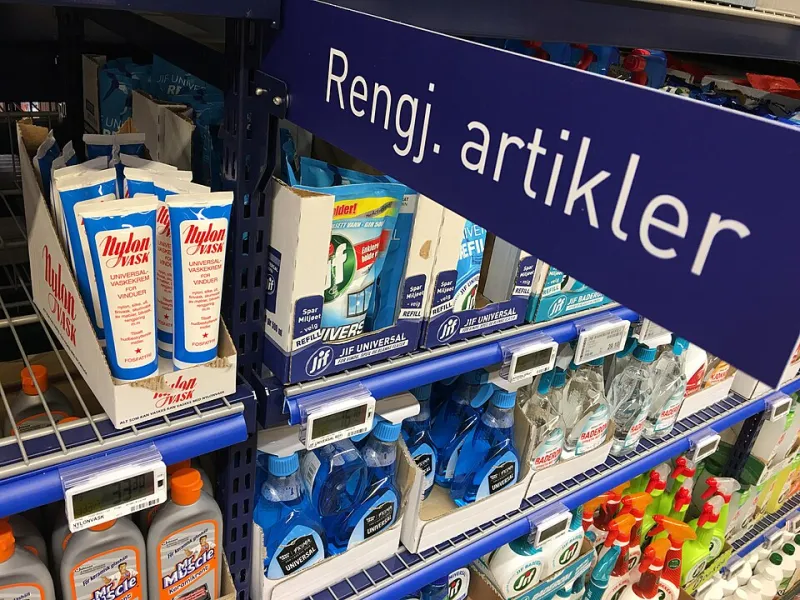
Photo: Wolfmann, CC BY-SA 4.0, via Wikimedia Commons
Somewhere between a regional supermarket chain's buyer call and a software company's quarterly review, the language of the grocery store became the language of marketing. Executives who have never stocked a cooler talk about 'shelf presence.' Product managers describe their app's placement in a menu as an 'endcap.' To use these terms well — or to recognize when they're being stretched past their meaning — it helps to know where they came from.
Why Grocery vocabulary Traveled So Far
Supermarket retail was arguably the first marketing environment where success could be measured at the level of square inches. A grocery aisle is a fixed, finite space; every product on it competes for attention within seconds of a shopper walking past. That pressure produced a precise working vocabulary, and because consumer packaged goods (CPG) companies were among the first to build large, sophisticated marketing organizations in the United States, their internal language spread wherever CPG alumni went.
Today the words persist in three overlapping contexts: literal retail (a brand negotiating with Kroger or Walmart), brand marketing generally, and — increasingly — digital product design, where 'shelf' has become a metaphor for any ranked list of options.
The Core Glossary
Planogram. A diagram, often produced by software, mapping exactly where each product sits on a shelf or fixture. Retailers use planograms to standardize layouts across hundreds of stores; brands fight for favorable positions within them. Figuratively, any carefully sequenced arrangement — a homepage grid, a retail media placement — may be called a 'planogram moment.'
Endcap. The display unit at the end of an aisle, facing main traffic lanes. Because endcaps intercept shoppers without requiring them to enter the aisle, they command premium fees and are among the most contested placements in a store. In broader usage, an endcap is any high-visibility placement that captures attention before a customer reaches the 'main' selection.
Shelf presence. A product's ability to attract notice at the point of purchase — a function of packaging design, color, size, and position. Marketers now apply the phrase to anything competing in a crowded visual field, from app icons to thumbnail images in search results.
Impulse buy. A purchase made without prior intent, typically triggered by placement, price, or display. Classic impulse categories include candy at checkout and cold drinks near the entrance. Digital analogues include one-click add-ons and limited-time offers surfaced at payment.
Facing (or facings). The number of identical packages visible from the front of a shelf. More facings mean more visibility and, historically, more sales. 'We need more facings' is both a literal retail request and a common shorthand for wanting more share of attention anywhere.
Slotting fee. A payment a manufacturer makes to a retailer to secure shelf space for a product, particularly for new items. Slotting fees remain controversial in trade circles because they favor large suppliers, and the term is occasionally borrowed to describe any pay-to-play placement arrangement.
Trade promotion. Marketing directed at retailers and distributors rather than end consumers — discounts, display allowances, and fees designed to win distribution and placement. It is the counterpart to consumer promotion, which targets shoppers directly.
Private label. A retailer's own brand, such as Kroger's store brands or Costco's Kirkland Signature. The growth of private label has reshaped negotiations between national brands and retailers, since the retailer controls both the shelf and its own competing product.
Shrink. Retail shorthand for inventory lost to theft, damage, or administrative error. It appears in marketing-adjacent conversations mainly when pricing and packaging decisions are under discussion.
Velocity. Not the physics term — in retail, velocity means the rate of sales per store or per point of distribution. A product can have broad distribution but weak velocity, which usually signals that placement support will not be renewed.
Reading a Trade Call Without Getting Lost
A CPG trade conversation tends to move quickly through compressed jargon. A typical exchange might sound like: 'Velocity is soft in the Northeast; we're asking for an endcap in Q3 with a feature price, and we'll trade a heavier promo allowance for two extra facings.' Translated: sales per store are underperforming in one region; the brand wants a high-visibility end-of-aisle display supported by a temporary price reduction; and it is willing to pay a larger discount to the retailer in exchange for more front-facing shelf space.
Notice what the vocabulary accomplishes. Every term compresses a negotiation about money, space, and attention into a single word. That compression is precisely why the language escaped the grocery aisle.
When the Metaphor Breaks
Borrowed terms are useful until they obscure more than they reveal. Calling a mobile app's navigation menu a 'shelf' is evocative, but digital placement lacks the physical constraints — finite square footage, restocking labor, spoilage — that gave the original terms their meaning. A website can add inventory without limit; a planogram cannot. Professionals who understand the literal origin of these words are better equipped to notice when the analogy is doing real analytical work and when it is merely decorating a slide.
A Short History, Briefly
The self-service supermarket, pioneered in the United States in the 1930s with chains like King Kullen, created the conditions for this lexicon. Once shoppers served themselves, packaging became the salesperson, and the store layout became a marketing instrument. The vocabulary that grew up around that shift — refined through decades of CPG trade practice — remains the most complete language marketing has for one enduring problem: how to win attention in a space where every inch is spoken for.