Merriam-Webster vs. the Marketing Department: When the Dictionary and the Industry Disagree
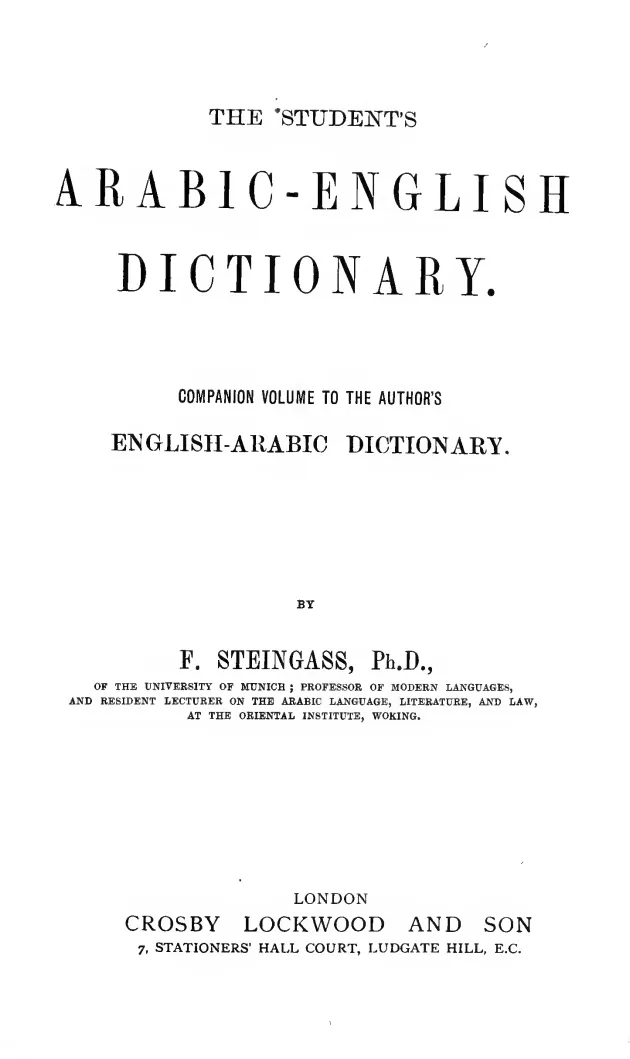
Photo: Francis Joseph Steingass, Public domain, via Wikimedia Commons
Marketing lives and dies by precise definitions. So we decided to hold the profession to its own standard: we took six terms that appear in virtually every brief, deck, and status meeting, and looked them up in actual dictionaries — Merriam-Webster, the closest thing America has to an official arbiter, and the Oxford English Dictionary, the historical record of the English language. What we found was instructive. In some cases, the dictionaries have caught up. In others, they are trailing the industry by a decade or more.
Brand: The Dictionary Gets It Mostly Right
Merriam-Webster defines a brand as a class of goods identified by name, a recognized make, or — in the older sense — a mark burned into livestock. The OED traces the word back to the Old English brond, meaning a burning piece of wood, before it came to signify ownership marks on cattle.
Marketers will find little to object to here. The livestock etymology is actually a useful teaching tool: a brand was originally a permanent mark that told you who owned something. The modern extension — brand equity, brand architecture, brand voice — is a professional elaboration the dictionaries have not fully absorbed, but the core concept holds. Score one for the lexicographers.
Influencer: The Dictionaries Caught Up, Quickly
Few terms have traveled from industry slang to household word as fast as influencer. Merriam-Webster added it in 2019, defining it as one who exerts influence — with a specific sense for people who generate content and monetize their followings. The OED followed with a dating of the social-media sense to the early 2000s.
The interesting wrinkle is usage drift. In agency parlance, "influencer" increasingly refers specifically to the individual creator, while "influencer marketing" describes the channel. The dictionaries capture the person; the industry has moved on to the ecosystem. It is a subtle gap, but one that matters when writing contracts and campaign briefs.
Viral: A Word the Dictionary Understands Better Than Most Marketers
Merriam-Webster's primary definition of viral is strictly medical: of, relating to, or caused by a virus. The secondary sense — rapidly spreading through online sharing — was formally added in the 2010s, though the usage dates back decades earlier.
Here the dictionary is, in a sense, more honest than the industry. Marketing teams use "viral" as an aspiration, a deliverable, even a line item: "Let's make this go viral." The dictionary's definition makes clear that virality is an observed outcome, not a strategy. Lexicographers, unlike some creative directors, do not promise results.
Engagement: The Clear Failure Case
If one term exposes the gap between the dictionary and the boardroom, it is engagement. Merriam-Webster offers: an appointment, a betrothal, a battle, or the state of being engaged. The OED adds military engagements and mechanical engagement of gears.
Not one of these definitions covers what a social media manager means by engagement — the measurable interactions (likes, shares, comments, saves) a piece of content generates. The professional sense is so specialized, and so quantified, that dictionaries have essentially declined to codify it. When you say "engagement is down," you are speaking a dialect the dictionary does not record.
Funnel: Borrowed Metaphor, Unborrowed Definition
The marketing funnel — awareness, consideration, conversion — appears in no dictionary as a marketing term. Merriam-Webster defines a funnel as a utensil for pouring liquids, or something that draws in and concentrates. The second sense is close, but the structured customer journey that marketers mean is entirely absent.
This is telling. The funnel is a metaphor borrowed from sales training materials of the early twentieth century, and despite a century of use, it remains industry-internal vocabulary. It suggests that lexicographers draw a line: metaphors become dictionary entries when the general public uses them, not just professionals.
Impressions: Where the Dictionary and the Ad Industry Part Ways
An impression, per Merriam-Webster, is a mark left by pressure, a mental effect, or a belief formed without firm evidence. The advertising sense — a single instance of an advertisement being served to a user — is absent entirely, despite the term anchoring media planning since the era of print rate cards.
The omission is notable because impressions are the currency of the entire media business. CPM pricing, reach estimates, and delivery reports all depend on a definition that lives in industry standards documents (notably those from the IAB), not in any general dictionary.
What the Gaps Teach Us
Three lessons emerge from this exercise.
First, speed matters. Dictionary entries can take a decade or more to formalize after a term enters common professional use. Anyone writing style guides or onboarding materials cannot rely on dictionaries alone for current marketing vocabulary.
Second, quantified meanings resist codification. Terms like engagement and impressions are defined by measurement standards, not linguistic usage. Their authoritative definitions live in industry bodies, which is why citing "the dictionary" in a dispute over these terms will lose you the argument.
Third, the dictionary is a floor, not a ceiling. Merriam-Webster and the OED capture the meanings a term has when the general public adopts it. Marketing's specialized senses — the ones that fill glossaries like this one — exist in the space between professional jargon and general usage. That space is exactly where marketing language evolves fastest, and exactly where a dictionary dedicated to the discipline earns its keep.
The next time a stakeholder challenges your terminology, checking the dictionary is a reasonable first step. Just be prepared for the possibility that the dictionary is the one out of date.