Ink Stains on the Pixel: What Print-Era Advertising Terms Actually Mean in a Digital World
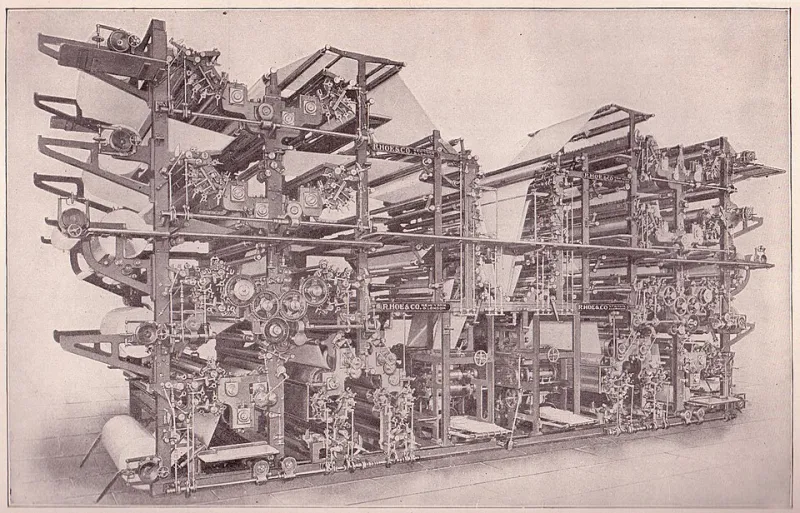
Photo: Sue Clark, Public domain, via Wikimedia Commons
Marketing borrows its language the way cities borrow their architecture: built on top of whatever stood there before. Scroll through a modern campaign brief and you will find terms coined by newspaper typesetters, radio producers, and billboard salespeople — professions that either no longer exist or bear little resemblance to their digital descendants.
Understanding where these words came from is more than trivia. It explains why certain digital conventions feel awkward, why clients and agencies occasionally talk past each other, and why some legacy terms deserve retirement.
Above the Fold
Then: In newspaper production, the fold was the horizontal crease where the paper was halved for display on newsstands. Stories and advertisements placed above that crease were the only ones visible to passersby, so the choicest headlines and premium ad placements lived there.
Now: Web teams borrowed the term to describe content visible in a browser window without scrolling. The metaphor fit for roughly a decade. Then screens proliferated — a 27-inch monitor, a 6-inch phone, and a foldable tablet all draw the "fold" in different places. Today, most practitioners treat "above the fold" as shorthand for "early in the scroll" rather than a fixed boundary. Google's own page layout guidance, introduced in 2012, reinforced the term's digital meaning by penalizing sites that buried content beneath a wall of ads.
Verdict: Still useful, but imprecise. Treat it as a priority signal, not a coordinate.
Rate Card
Then: A printed sheet listing a publication's advertising prices by placement, size, frequency, and season. Negotiating off the rate card was a ritual of media buying, and the card itself was a statement of a publication's self-assessed worth.
Now: Programmatic auctions made fixed pricing nearly obsolete in digital display, so the rate card survives mostly in podcast sponsorships, local broadcast, out-of-home advertising, and premium newsletter placements — channels where inventory is finite and human negotiation still governs. In digital media kits, "rate card" often means the starting point from which every buyer is expected to discount.
Verdict: Alive, but increasingly confined to channels the auction economy hasn't fully absorbed.
Column Inch
Then: The fundamental unit of print advertising space: one column wide, one inch deep. Pricing, editorial budgets, and even newsroom layoffs were calculated in column inches.
Now: Digital equivalents measure impressions, pixels, or session time, and none map cleanly onto a physical unit of space. The term survives mainly in public relations, where "earned column inches" is still used — somewhat anachronistically — to describe the volume of press coverage a campaign generated, even when that coverage is measured in digital mentions.
Verdict: A legacy unit that persists as idiom. Say "share of coverage" in analytics contexts; save "column inches" for the client who grew up reading the morning paper.
Run of Show
Then: Broadcast and live-event production: the minute-by-minute schedule governing a television broadcast, awards ceremony, or live read. Everyone from the stage manager to the network executive worked from the same document.
Now: Event marketing and webinar teams still use it faithfully. But it has also drifted into general project management, where a "run of show" may describe the agenda for a product launch livestream or an internal all-hands. The meaning has held remarkably well — arguably better than most borrowed terms — because the underlying discipline (sequenced, timed, shared) translates intact.
Verdict: Fully survived the migration.
Above the Line / Below the Line
Then: Coined in the 1950s by Procter & Gamble accountants: "above the line" agencies were paid a commission on media billings, which appeared above the line on financial statements; everything else — direct mail, promotions, collateral — fell below it. The accounting distinction hardened into an industry caste system.
Now: Digital marketing dissolved the boundary. A search ad is simultaneously mass-reach and directly accountable; an influencer partnership is both brand-building and performance-driven. Most strategists now speak of "brand" versus "performance" or "full-funnel" marketing instead. Yet the phrase lingers in agency structure and job titles, particularly in markets like the UK and in American holding companies with legacy divisions.
Verdict: Historically illuminating, practically obsolete. Knowing the origin prevents the term from being misused as a synonym for "traditional media."
Bleed
Then: Print production term for artwork extending past the trim edge, ensuring no unprinted white margin after cutting. A .125-inch bleed remains standard in US print specs.
Now: Genuinely unchanged. Digital design tools still ask for bleed settings, and any marketer ordering printed signage, trade show banners, or direct mail will encounter it. One of the few terms that migrated without metaphorical drift — because print itself persists.
Verdict: Fully intact.
Why the Metaphors Break Down
Legacy vocabulary survives because language is cheaper to reuse than to replace. But three patterns of breakdown are worth noting:
- The measurement mismatch. "Column inch" assumed space was the scarce resource. Online, attention is scarce and space is effectively infinite, so spatial metaphors mislead.
- The fixed-screen assumption. "Above the fold" presumed one canonical layout. Responsive, multi-device design removed the canonical fold.
- The pricing-model assumption. "Rate card" and "above the line" both assumed human negotiation and commission structures. Automation erased the economics that produced the language.
The Takeaway
For students and professionals alike, the practical rule is simple: use legacy terms when they communicate clearly to your audience, and know their origins well enough to recognize when the metaphor has quietly stopped working. A shared vocabulary is only useful as long as everyone using it means the same thing — a problem as old as the newspaper fold itself.