The Customer-Side Dictionary: What Your Jargon Sounds Like to Everyone Else
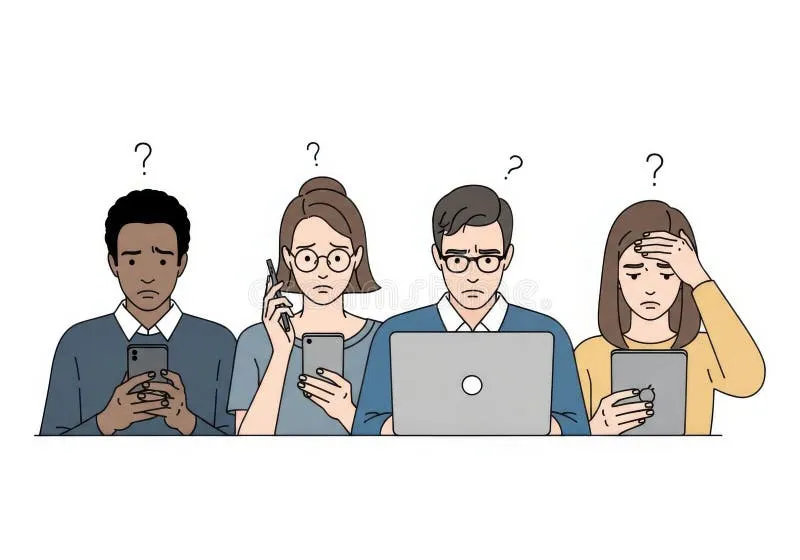
Photo: confused customer looking at smartphone marketing emails, via thumbs.dreamstime.com
Every discipline develops a private language, and marketing is no exception. We write 'omnichannel' in strategy documents. We promise 'personalization at scale.' We talk about 'brand voice' in workshops with sticky notes on the walls. These terms have precise, agreed-upon definitions within the industry — and almost none of them survive contact with an actual customer.
This entry in our glossary works in reverse. Instead of defining marketing terms for marketers, it defines them as the people on the other side of the screen experience them. The gap between the two definitions is where campaigns succeed or quietly fail.
Omnichannel: The Marketer's Definition vs. the Shopper's
In the deck: A seamlessly integrated approach in which every touchpoint — web, app, email, in-store — shares data and delivers a consistent experience.
In the customer's life: "Why does the website not know what's already in my cart when I call support?"
A true omnichannel operation means a shopper can start a purchase on a laptop in Chicago, abandon it, and pick it up on a phone during a layover in Denver without friction. When it works, customers don't notice it — they simply never encounter the seams. When it doesn't, they encounter every seam at once: an email promoting an item they already bought, a store associate who can't see their online order, a loyalty discount that vanishes between channels.
The customer's definition of omnichannel is not architectural. It is experiential: the brand remembers me everywhere, or it doesn't. There is no partial credit.
Personalization: A Promise That Cuts Both Ways
In the deck: Delivering relevant content, offers, and product recommendations based on individual customer data and behavior.
In the customer's life: A mixture of delight and unease, depending entirely on execution.
Personalization is perhaps the most misunderstood term in the modern vocabulary because customers experience its failure modes more vividly than its successes. A well-timed reorder reminder for printer ink feels helpful. A retargeting ad that follows a shopper around for weeks after they've already purchased the item — or after they decided against it — feels broken. And a message that references data the customer never consciously shared, such as a birthday offer from a retailer they visited once in 2019, tends to produce the opposite of the intended warmth.
The lesson embedded in the customer's definition: relevance is welcome; surveillance is not. The line between the two is drawn by transparency and timing, not by the sophistication of the data pipeline. Marketers who define personalization solely as a technology capability miss that customers define it as a relationship behavior.
Brand Voice: What Customers Actually Hear
In the deck: The consistent personality and tone a brand expresses across all communications, codified in guidelines covering vocabulary, cadence, and values.
In the customer's life: Whether the brand sounds like a person, a corporation, or something worse — a corporation pretending to be a person.
Brand voice guidelines run to dozens of pages, but customers render their verdict in seconds. A casual, emoji-filled tweet from an insurance company during a natural disaster reads as tone-deaf, no matter how well the voice chart was executed. A plain, direct email about a flight cancellation reads as respectful, even if it lacks personality.
The consumer-side definition of brand voice might be stated as: the degree to which a company's communications match the emotional context of the moment. Consistency matters less to customers than appropriateness. Many brands learned this the hard way when scheduled social posts ran alongside breaking news, or when automated apology emails arrived with the wrong merge fields — small failures that revealed the machinery behind the voice.
Engagement: The Metric That Means Nothing on Its Own
In the deck: Any measurable interaction with brand content — clicks, likes, shares, opens, time on page.
In the customer's life: Usually an accident.
Here the definitional gap is widest. Marketers treat engagement as a signal of interest and intent. Customers, however, click by mistake, scroll past videos while the sound is off, and open emails on their phone while walking to the car. A substantial share of what registers as engagement is ambient behavior, not brand affinity.
This is not an argument that engagement metrics are worthless — they remain useful for comparing content against itself. It is an argument that the term describes our activity, not theirs. Customers would define engagement, if they used the word at all, as something closer to loyalty or attention, both of which are scarcer and harder to measure than a click.
Closing the Definitional Gap
The practical takeaway is not that marketers should abandon these terms internally. Shared vocabulary makes teams faster and strategy documents clearer. The takeaway is that every term in our glossary should carry a second entry: the customer's version.
Before launching a campaign, run each headline term through a simple test. If a customer heard the word 'personalization' or saw the campaign, would the experience match the promise? Would they describe the outcome in the same words the brief uses? When the two definitions diverge, the customer's definition wins — because it is the only one that determines whether they come back.
The most important dictionary in marketing is not the one we write. It is the one our audience keeps, silently and constantly, in their heads.